What is Bench Laboratory Research and Why is it Important?
Bench Laboratory Research plays a crucial role in scientific progress. This type of research provides a fundamental understanding of biological processes. It allows scientists to test hypotheses in controlled environments. Through experiments, researchers can manipulate variables and observe outcomes.
The significance of Bench Laboratory Research extends to many fields. It impacts medicine, environmental science, and technology. Each experiment conducted in a lab brings new insights. However, not every experiment leads to breakthroughs. Some fail or yield unexpected results. These outcomes can be just as valuable. They challenge existing theories and lead to new questions.
In the pursuit of knowledge, reflection is vital. Researchers must consider how each finding fits within the larger context. Bench Laboratory Research is a journey filled with both successes and setbacks. Each step, whether forward or backward, shapes our understanding of the world.

Definition of Bench Laboratory Research
Bench laboratory research refers to scientific experimentation conducted in a controlled environment. Typically, this research happens in labs that focus on biological or chemical processes. Researchers use various methods to explore hypotheses. They analyze data and obtain results that contribute to broader scientific knowledge.
Conducting bench research is crucial for many reasons. It provides a foundation for understanding complex biological systems. For instance, researchers might study cellular behavior under specific conditions. These findings can lead to advances in medicine or environmental science. However, results may not always meet expectations. The initial hypothesis may be incorrect, leading to questioning methods or approaches.
Tips: Keep a detailed lab notebook. Note each step and observation. This practice helps track progress and reflects on failures. Collaborate with others. Fresh perspectives can spark new ideas. Reflect on failed experiments. They offer valuable lessons. Each misstep can guide future research. Embrace the process; the journey is as important as the outcome.
What is Bench Laboratory Research and Why is it Important?
| Dimension |
Description |
Importance |
| Research Focus |
Basic and applied research in life sciences, chemistry, and materials science. |
Essential for understanding fundamental biological processes and developing new technologies. |
| Techniques Used |
Molecular cloning, cell culture, electrophoresis, chromatography. |
Allows precise manipulation of biological systems and materials for research and applications. |
| Typical Duration |
Varies, typically from weeks to months depending on the complexity of the research. |
Research timelines can affect funding, resource allocation, and project outcomes. |
| Outcomes |
Publications, patents, prototypes, and new methodologies. |
Contributes to scientific knowledge and can lead to commercial products and therapies. |
| Collaboration |
Often involves interdisciplinary teams from various fields of science. |
Enhances innovation and problem-solving through diverse expertise and perspectives. |
Key Techniques Used in Bench Laboratory Research
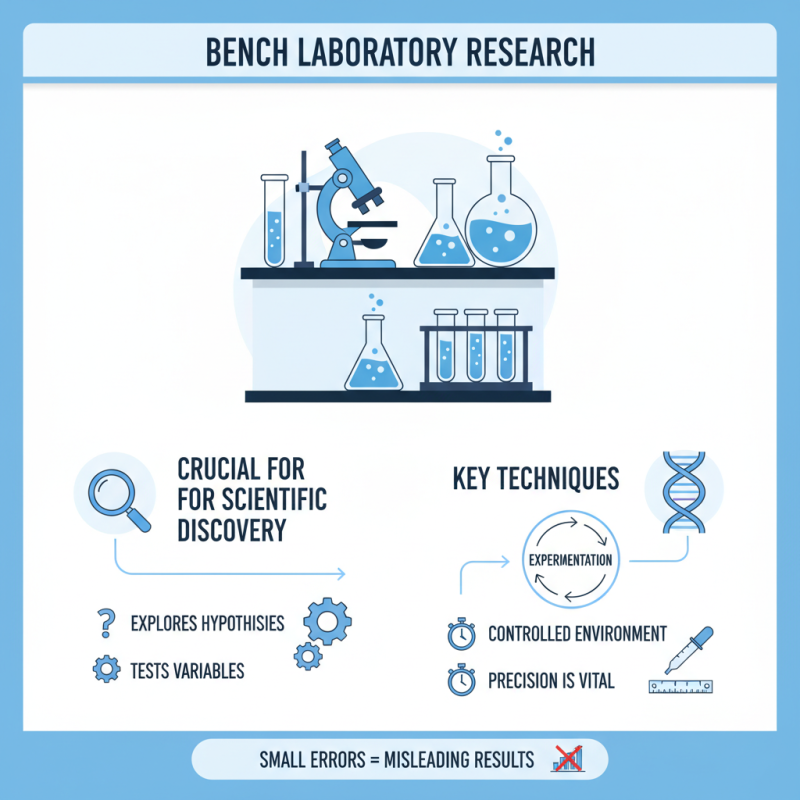
Bench laboratory research is crucial for scientific discovery. This type of research often utilizes several key techniques to explore various hypotheses. One of the primary methods is experimentation. Scientists conduct experiments to test specific variables in a controlled environment. Precision is vital, as even small errors can lead to misleading results.
Another important technique is data analysis. After gathering data, researchers must analyze it thoroughly. This step can be messy and sometimes overwhelming. The right tools help, but they can also complicate the interpretation process. Misunderstanding the data can lead to incorrect conclusions, and researchers often have to reassess their findings.
Observation is also a cornerstone of bench laboratory research. This method involves looking closely at samples and reactions. Careful observation can reveal unexpected results. However, it requires patience and a keen eye. Many researchers find themselves struggling to notice subtle changes. This part of research holds both challenges and surprises, making it a fascinating yet imperfect journey.
Applications of Bench Laboratory Research in Various Disciplines
Bench laboratory research is essential in various scientific fields. It involves hands-on experimentation and analysis. This type of research allows scientists to test hypotheses and gain insights. These insights can lead to breakthroughs in health, materials science, and environmental studies.
In the medical field, bench research plays a crucial role. Scientists conduct experiments to understand diseases better. They test new drugs and observe their effects. Results can guide clinical trials and treatments. In materials science, researchers develop new materials. They experiment with compounds and their properties. Each failure provides learning opportunities, shaping future designs.
In environmental science, bench research helps tackle pollution issues. Scientists analyze samples to identify harmful substances. They experiment with solutions to reduce waste. However, the process is not always straightforward. Researchers may face setbacks. These challenges prompt reflection and innovation, ultimately driving progress.
Significance of Bench Laboratory Research in Scientific Advancements
Bench laboratory research plays a crucial role in scientific advancements. It is a foundational element that helps transform theories into practical applications. Research conducted at this level often leads to significant breakthroughs. For instance, a 2021 report indicated that over 50% of new medical therapies originated from bench research findings. This shows how vital this phase is for future innovations.
Tips: To stay updated, read recent scientific journals regularly. Engage with online research communities to broaden your perspective.
Despite its importance, bench research can face challenges. Many experiments yield inconsistent results, leading to frustration. Researchers may grapple with reproducibility issues, which hinder scientific progress. A survey revealed that nearly 30% of scientists have faced this problem in their studies. This reality calls for a more stringent approach to data handling and experimental design.
Tips: Document every step meticulously. Collaborate with peers for diverse viewpoints.
Understanding the significance of bench laboratory research is essential. It acts as a bridge between basic science and real-world applications. The outcomes from these labs drive innovations that can change lives. However, consistent reflection on methodologies and results is necessary for continuous improvement.
Importance of Bench Laboratory Research in Scientific Advancements
Bench laboratory research plays a crucial role in driving scientific advancements by facilitating various stages of research, from basic science to clinical applications. This chart visualizes the number of research projects in different areas, highlighting the significance of each domain within the bench laboratory setting.
Challenges and Limitations of Bench Laboratory Research
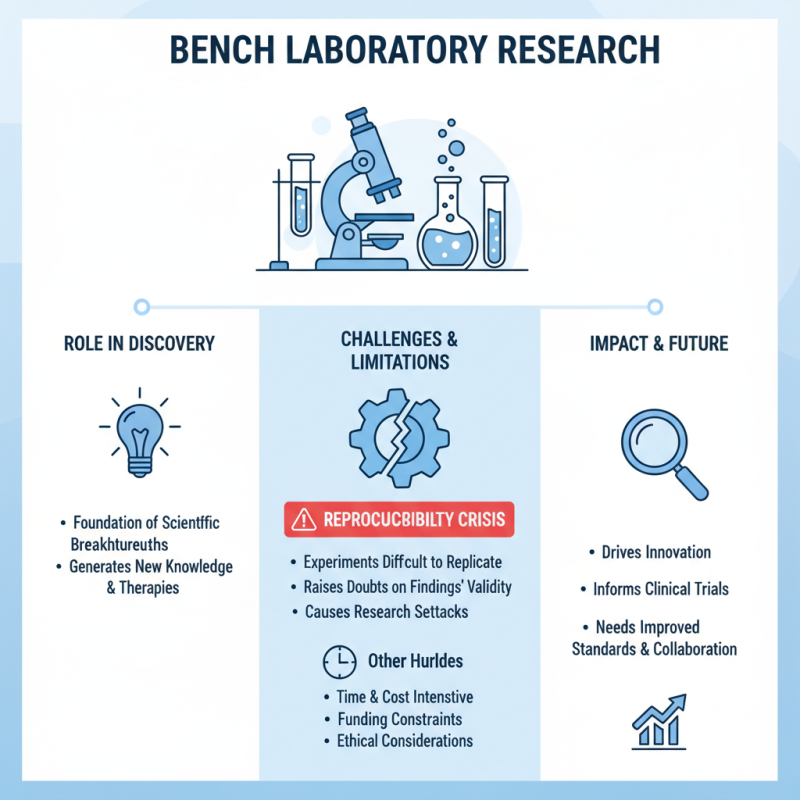
Bench laboratory research plays a crucial role in scientific discovery. However, it comes with various challenges and limitations. One significant challenge is the reproducibility crisis. Many experiments yield results that are difficult to replicate. This issue raises concerns about the validity of findings.
Another limitation is the oversimplification of biological systems. Researchers often rely on cell lines or animal models that do not fully mimic human physiology. These models can lead to misleading conclusions. For instance, drug responses observed in these models may not translate to actual human patients.
Moreover, bench research can be time-consuming and expensive. Limited resources can hinder the scope of experiments. Often, this leads to a narrow focus, limiting potential discoveries. Researchers must also navigate ethical dilemmas, especially when working with living organisms. These complexities prompt ongoing reflection about methods and approaches in the lab.