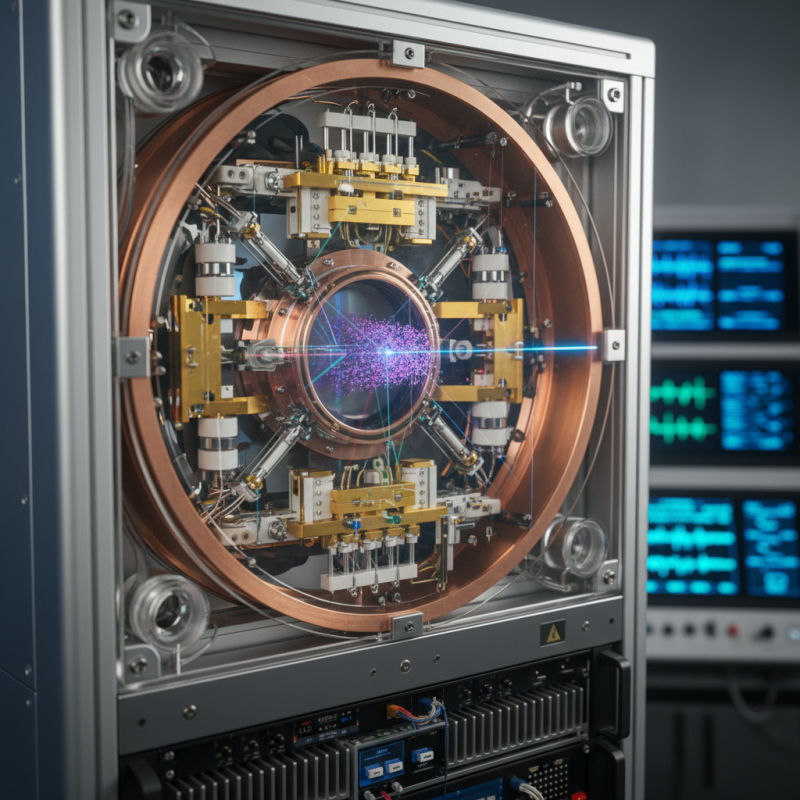
What is a Caesium Clock and How Does It Work?
The Caesium Clock is a marvel of modern technology. It represents a crucial advancement in timekeeping. Unlike conventional clocks, it uses the vibrations of caesium atoms to measure time with remarkable accuracy.
At the heart of the Caesium Clock is a simple yet profound principle. Caesium atoms resonate at a specific frequency when exposed to microwave radiation. This frequency is incredibly stable, making it ideal for precise time measurement. These clocks are so accurate that they can lose or gain only one second over millions of years.
However, perfection is elusive. Even with this advanced technology, challenges remain. Environmental factors can affect measurements, leading to slight inaccuracies. This raises questions about the reliability of our timekeeping systems. Despite its strengths, the Caesium Clock teaches us about the limitations of technology in capturing the essence of time.
What is a Caesium Clock?
A caesium clock is a highly precise timekeeping device. It relies on the vibrations of caesium atoms to measure time. These clocks are incredibly accurate, deviating only one second over millions of years. But how do they work?
Inside a caesium clock, there are atoms of caesium-133. When these atoms are exposed to microwave radiation, they oscillate at a specific frequency. This frequency is remarkably stable, making it ideal for measuring time. The clock counts these oscillations to define the second. Some processes can introduce errors, though. The environment and temperature can affect the measurements in subtle ways.
Despite their accuracy, caesium clocks are not easy to maintain. Regular calibration is necessary to ensure precision. Researchers continue to explore ways to improve these clocks. Even a small shift in measurements raises questions about accuracy in global positioning systems or telecommunications. The quest for perfect timekeeping pushes the boundaries of science.
Historical Development of Caesium Clocks
The history of caesium clocks is fascinating. The journey began in the 1950s. Scientists aimed to create precise timekeeping devices. They focused on the properties of caesium atoms. In 1955, the first successful caesium atomic clock was built. This made a significant leap in timekeeping accuracy.
As time went on, improvements continued. By the 1970s, more advanced designs emerged. These clocks used vibrations of caesium atoms to measure time. Each oscillation provides a consistent time reference. However, there were challenges in maintaining stability. Early models were not perfect. They required constant adjustments to remain accurate.
Researchers reflected on these limitations. Even the best instruments faced drift over time. Despite this, the development of caesium clocks laid the groundwork for modern timekeeping. They continue to influence technologies today. The pursuit of perfect accuracy is ongoing. Each step in this journey teaches valuable lessons.
Principles of Operation: How a Caesium Clock Works
A Caesium clock operates based on the principles of atomic timekeeping. It relies on the vibrations of caesium atoms when they are energized. These atoms resonate at a specific frequency—9,192,631,770 times per second. This precise frequency serves as the standard for measuring time in the International System of Units (SI). According to the International Bureau of Weights and Measures, a Caesium clock has an accuracy of about one second over 30 million years.
When a Caesium clock is functioning, microwaves are directed at a cloud of caesium atoms. These microwaves are tuned to the resonance frequency of the atoms. When the frequency aligns, the atoms change energy states, emitting a signal that is measured and used to keep time. This method is highly accurate, yet it is important to acknowledge its limitations. For instance, environmental factors like temperature and magnetic fields can cause slight variations in measurements.
Despite its high precision, the Caesium clock is not infallible. Over time, it faces challenges. For example, even the most advanced models show deviations due to quantum effects. This highlights our ongoing quest for better timekeeping technologies. Scientists are now exploring optical lattice clocks that promise even greater precision. However, these advancements remind us that perfection in timekeeping is still a work in progress.
Applications of Caesium Clocks in Modern Technology
Caesium clocks are pivotal in modern technology due to their remarkable accuracy. These clocks use the vibrations of caesium atoms for precise timekeeping. In fact, they can maintain an accuracy of one second over millions of years. Because of this accuracy, caesium clocks are essential for Global Positioning System (GPS) satellites. They ensure that we receive precise location data.
In telecommunications, caesium clocks play a vital role in synchronizing data transmission. This synchronization reduces delays that can affect communication quality. According to a report from the National Institute of Standards and Technology, accurate time synchronization can enhance system efficiency by up to 90%. This is crucial in sectors like finance, where microsecond discrepancies can lead to significant losses.
Tips: Ensure your technology relies on synchronized timing, especially for critical operations. Regular maintenance of timing devices can prevent costly errors. Also, consider employing backup systems for redundancy. An overlooked clock can disrupt entire networks.
Monitoring advancements in timekeeping technology is essential. While caesium clocks are the gold standard today, innovation continues. New atomic clocks may emerge, offering even better performance. These developments warrant attention for anyone invested in precision technologies.
Applications of Caesium Clocks in Modern Technology
Advantages and Limitations of Caesium Timekeeping
Caesium clocks are known for their accuracy in timekeeping. These devices rely on the vibrations of caesium atoms. One key advantage is precision. Caesium clocks can maintain time to within a billionth of a second. This makes them reliable for scientific applications.
However, there are limitations. They can be expensive to maintain. The technology requires specific conditions for proper functioning. Environmental factors can affect accuracy. For example, temperature changes may interfere with measurements. There’s also the energy consumption aspect. Caesium clocks typically consume more power than other timekeeping technologies.
In practice, the extreme precision of caesium timekeeping poses challenges. It requires skilled technicians and careful handling. This sets a high barrier for widespread use. While they are remarkable tools, their practicality often hinges on how well we manage these technical hurdles.