Choosing a Fabric Testing lab in China is not just a price comparison. A failed colorfastness or seam-strength test can delay a shipment, trigger retesting, and leave buyers arguing over which sample was tested. The right lab should explain its methods clearly, handle your fabric type, and return results you can trace to a specific sample.
The need is substantial. Textile Exchange’s Materials Market Report 2024 estimates that global fiber production reached 124 million tonnes in 2023. That scale brings varied fibers, finishes, and performance claims to verify. A lab’s ISO/IEC 17025 accreditation is a useful starting point, but check its current scope: accreditation for one method does not automatically cover every fabric test. Ask for the exact standard, conditioning procedure, sample size, equipment, and report format. Small details matter.
Textile scientist Dr. Seshadri Ramkumar’s published work offers a practical reminder, paraphrased here: test methods should reflect the material’s real-world use. A result is only as useful as the test behind it. For a China-based supplier, confirm whether the lab can communicate in your working language, meet your production schedule, and arrange witnessed testing when needed. Ask how it handles borderline results and retests, too. That conversation may feel less polished than a sales presentation. It can be more revealing. The best choice is not always the cheapest or closest lab; it is the one whose competence, scope, and reporting fit the decision you need to make.
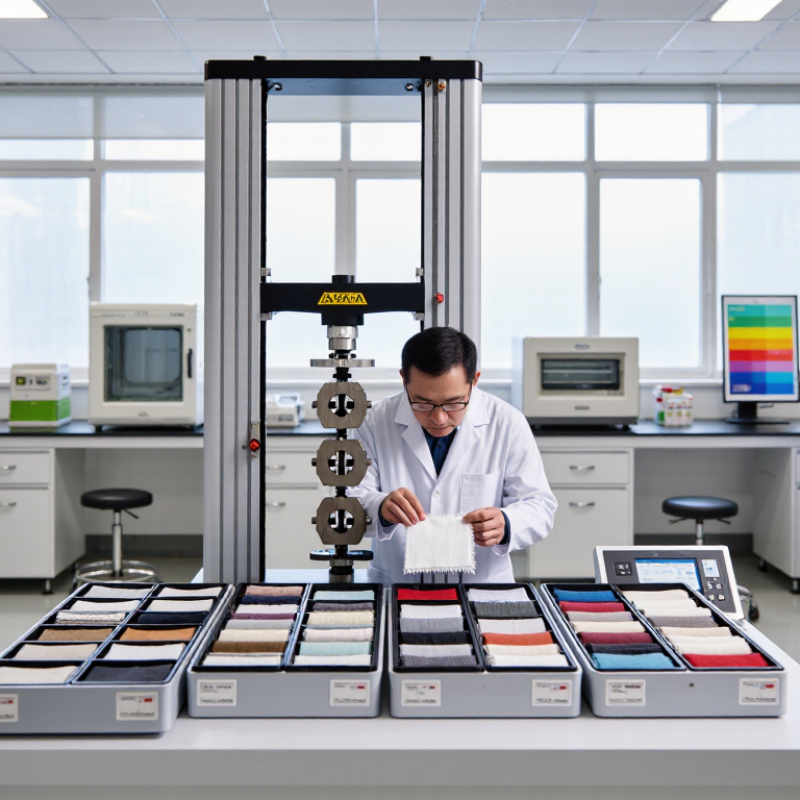
When choosing a fabric testing lab in China, ask how it controls the atmosphere before testing. ISO 139 specifies a standard atmosphere of 20°C ± 2°C and 65% ± 4% relative humidity for textile conditioning and testing. These figures are not minor details. Moisture in a sample can affect results such as mass, dimensions, and strength. Ask whether the lab records temperature and humidity during conditioning, not just when the test begins. A clear record helps you compare results across batches or facilities.
Check how specimens are prepared and allowed to reach moisture equilibrium. The lab should explain its procedure and identify any departures from the standard conditions. Small details matter. A fabric taken from a humid warehouse may need time to settle in the test atmosphere; handling it too soon can distort comparisons. Ask for equipment calibration records and the conditions stated in the report. A tidy certificate does not erase a weak conditioning record. Still, no single atmosphere makes every material behave identically, so confirm that the chosen method fits your fabric and test purpose. It is easy to overlook that last point.

When choosing a fabric testing lab in China, check whether its ISO/IEC 17025 accreditation covers each test you need. Accreditation applies to a defined scope, not automatically to every service a laboratory offers. A valid certificate alone is not enough.
Compare your test list with the lab’s current scope document. Look for the exact property, method, and material type, such as colorfastness to washing, fiber composition, or tensile strength. Small differences matter. A lab may be accredited for one method but use another for your sample. Ask whether any test will be subcontracted, and request clear details before sending fabric swatches.
Review a sample report for the test method, result units, sample identification, and any stated limitations. Confirm how samples are labeled and stored; a misplaced swatch can complicate a good result. Accreditation supports confidence in technical competence, but it does not guarantee that every report fits your product decision. It is easy to focus on the certificate and overlook the fine print. That deserves a second look.
Tips: Send the lab your required tests and destination requirements in writing. Ask it to mark which tests fall within its accredited scope, and keep that confirmation with the quotation.
Check that the lab’s ISO/IEC 17025 accreditation scope covers each required textile test and the exact method edition you need.
Selected ISO textile test methods and the publication years of the editions shown. These dates do not indicate whether an edition is currently the latest. Before placing an order, confirm the applicable edition and verify that each method is explicitly listed in the lab’s accreditation scope.
Choosing a fabric testing lab in China starts with matching the test to the failure you need to understand. ISO 105-X12:2016 evaluates colour transfer during rubbing, using dry and wet rubbing cloths. Results are assessed on a staining grey scale from 1 to 5. Ask the lab to report both conditions, specimen details, and individual ratings. A high dry rating can conceal poor wet performance. They are not interchangeable.
ISO 12947-2:2016 uses the Martindale method to assess abrasion until fabric breakdown. Request the applied pressure, test endpoint, and cycle count, rather than a simple “pass.” Textile Exchange’s Materials Market Report 2024 estimated global fibre production at 124 million tonnes in 2023. That scale reflects a wide range of fibre blends and constructions, so results need to match the actual fabric and intended use. I would compare like with like: identical conditioning, construction, and test settings. One result still cannot predict every form of wear. A clear report helps, but I would also check whether the lab explains any deviations and uncertainties.
How to Choose the Best Fabric Testing Lab in China?
Assess Sample Handling, Turnaround Times, and Test Report Details
A capable fabric testing lab should explain how it receives, labels, and stores samples. Ask whether each piece needs a minimum size and whether samples must be conditioned before testing. A simple intake checklist can prevent delays caused by missing details or unsuitable material. Small details matter. For example, a coated fabric may need careful cutting to avoid damaging its surface. Ask how the lab records sample condition and identifies each test piece.
Turnaround time should be specific, not just “fast.” Request an estimated completion date and ask what could delay the work, such as repeat testing or a busy period. Check that the report names the test methods, units, results, and any relevant limitations. Clear reports make it easier to compare fabrics and discuss findings with suppliers. If a result seems unexpected, ask whether the lab can explain the method and review the sample history. This step is easy to overlook.
Tips: Send a sample description with each shipment, including fiber content and fabric construction, if known. Confirm the report format before testing. Keep a retained piece from the same batch for comparison; it may not resolve every question, but it gives you a useful reference.
| Evaluation Dimension | What to Verify | Strong Evidence to Look For | Warning Signs | Suggested Weight |
|---|---|---|---|---|
| Accreditation and test scope | Check whether the laboratory’s accreditation covers the specific textile tests and methods you need. | A current accreditation certificate and scope listing the relevant methods. Confirm the scope directly with the accreditation body; accreditation should not be assumed to cover every test a lab offers. | A general accreditation claim without a current scope, or a requested test that is outside the listed scope. | 20% |
| Sample acceptance and identification | Ask how samples are labeled, logged, photographed, and linked to your purchase order or sample reference. | Written intake instructions, unique sample IDs, and confirmation of received sample condition and quantity. | Samples are accepted without clear identification or there is no traceable intake record. | 15% |
| Sample quantity and preparation | Confirm the required dimensions, quantity, conditioning, and any special preparation for each requested method. | Method-specific requirements are provided before shipment, with the lab explaining how insufficient or damaged samples will be handled. | A single generic quantity is promised for all tests, or preparation requirements are not clarified. | 10% |
| Sample storage and return | Agree on storage conditions, retention period, disposal, and return shipping before testing begins. | Written confirmation of sample retention and return or disposal arrangements, including any applicable fees. | No defined procedure for locating, retaining, or returning leftover material. | 10% |
| Turnaround time | Request an estimated completion date for the exact test package and ask when the clock starts. | A written estimate stating whether the schedule begins after sample receipt, acceptance, or payment, and how delays are communicated. | An unconditional “fast” or “same-day” promise without checking the methods, sample condition, or workload. | 15% |
| Method selection and applicability | Confirm the test method, edition, conditioning requirements, and whether it matches the buyer’s specification or destination market. | A quotation naming the method and edition, such as ISO 13934-1 for tensile properties, ISO 13937-2 for tear force, or ISO 105-X12 for rubbing colour fastness, when applicable. | The quotation says only “fabric test” or substitutes a method without approval. | 10% |
| Test report detail | Review a redacted sample report for sample identification, methods, results, units, test conditions, and any deviations. | Results are clearly tied to the submitted sample; the report identifies the method and relevant conditions and distinguishes measured results from pass/fail conclusions. | Missing units, unclear sample references, unexplained deviations, or a pass/fail statement without supporting results. | 15% |
| Communication and corrective action | Establish who will answer technical questions and how the lab handles unclear specifications, retesting, or result queries. | A named technical contact, a documented process for queries, and clear approval before any change to the agreed test plan. | Technical questions are redirected without resolution or the test plan changes without written approval. | 5% |
Note: Turnaround times and sample requirements vary by method, workload, and sample condition. Obtain a written, test-specific quotation and schedule before sending samples. The ISO methods listed are examples; confirm the required method and edition against your product specification.
A strong fabric testing lab should show more than polished reports. Ask for recent proficiency-testing or interlaboratory comparison results that match your material and test method. A passing score in colorfastness testing says little about tensile strength if those methods were not assessed. Check how often the lab participates and whether it investigates unusual results.
Look beyond a certificate. Confirm that the lab’s accredited scope covers the specific method you need, then ask how staff handle failed comparisons. Do they review equipment, sample conditioning, and calculations? Their answers reveal whether quality control is routine or merely paperwork. Small details matter.
Measurement uncertainty also deserves a clear explanation. Request the uncertainty value for the test, its coverage factor, and the main sources included, such as instrument resolution or operator variation. Compare uncertainty with your product tolerance: a result close to a limit may not support a confident pass-or-fail decision. Ask whether uncertainty is reported on the final document, not only discussed by sales staff. Calculations can depend on assumptions, and not every lab explains them neatly. That is worth probing. A careful lab will describe its limits plainly and tell you when a result needs cautious interpretation.
2106 N Glassell St, Orange, CA 92865
(714)-754-6669 | sale@site_be823a56-9df9-438e-acac-cd7d504ea0ad
Monday: 8:00 AM – 4:30 PM
Tuesday: 8:00 AM – 4:30 PM
Wednesday: 8:00 AM – 4:30 PM
Thursday: 8:00 AM – 4:30 PM
Friday: 8:00 AM – 4:30 PM