Choosing the best Small Laboratory Incubator is less about finding the most features and more about matching performance to the work. A compact unit may suit cell culture, sample conditioning, or routine microbiology, but “small” does not guarantee stable conditions. A temperature display can look reassuring while samples near the door experience greater fluctuation. Details matter.
Industry context helps, but it cannot identify a universal winner. Grand View Research’s laboratory-equipment market analysis tracks demand across a broad range of instruments; it does not establish that one incubator design is best for every laboratory. The World Health Organization’s Laboratory Biosafety Manual, fourth edition (2020), emphasizes assessing procedures and risks in their specific setting. That principle applies here: selection should begin with the samples, operating conditions, and daily workflow—not a feature list alone.
Compare usable chamber volume, temperature uniformity, recovery after door opening, alarm functions, and cleaning access. For CO₂-dependent cultures, examine gas control and humidity management, then confirm that the stated specifications match your required conditions. A crowded 20-liter chamber may be less useful than a smaller, well-organized one. Power use, noise, service access, and available bench space also affect everyday performance. No single specification tells the whole story. Published specifications may not reflect a laboratory’s actual loading pattern, so independent verification is worth considering. This guide explains how to weigh those trade-offs and choose an incubator that fits both the experiment and the room.
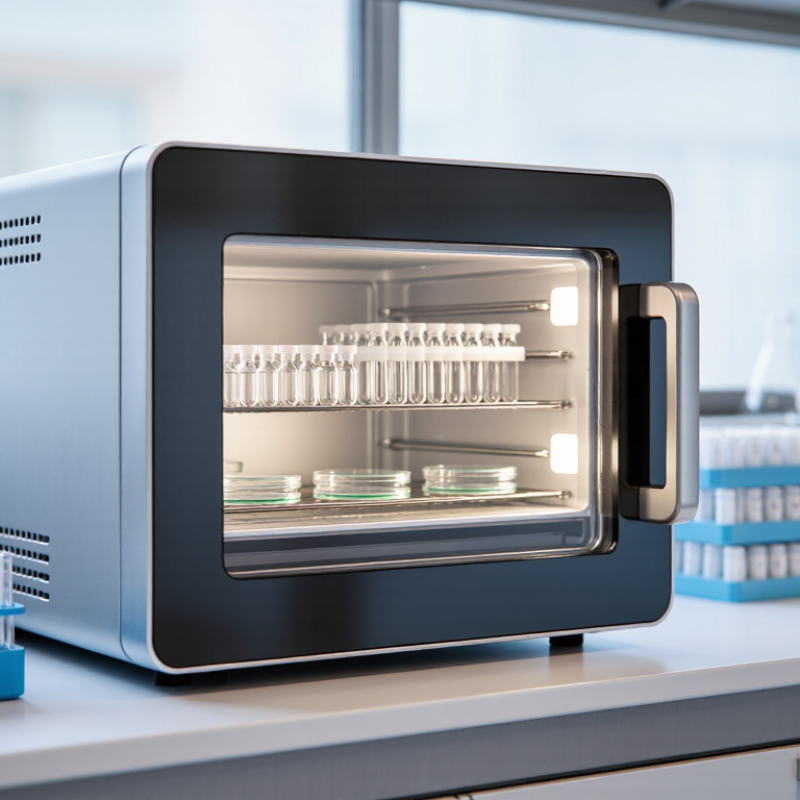
A small laboratory incubator is an insulated chamber that keeps samples within a selected temperature range. Depending on its design, it may support cell cultures, prepared media, or other temperature-sensitive materials. It is not simply a warm box. A heating element raises the chamber temperature, while a sensor and controller monitor conditions and adjust the heat. A fan may circulate air to reduce temperature differences between shelves.
Users set a target temperature and allow the chamber to stabilize before loading samples. A calibrated, independent thermometer can help check the displayed reading, especially after installation or servicing. Some incubators also control humidity or carbon dioxide, but those features are not standard.
Small, but useful.
A compact chamber fits limited bench space, though tightly packed containers can block airflow and create uneven conditions. It is easy to assume the display tells the whole story; it does not.
Routine care matters. Clean spills promptly using methods compatible with the unit, and avoid overloading shelves. Opening the door lets warm air escape, so frequent checks can cause temperature swings. For sensitive work, record the setpoint and actual readings, and follow the sample protocol.
There is a practical trade-off: compact units save space, but may offer less room for consistent placement and monitoring.
A few degrees can matter.
Small laboratory incubators differ by temperature control, atmosphere, and motion. A standard benchtop incubator suits routine culture work. Natural-convection models move air gently, while forced-air models recover temperature faster after the door opens. That speed can matter during busy sampling. It can also dry exposed plates more quickly.
CO2 incubators support mammalian cell culture, often with a 5% CO2 setting and a humidified chamber. Refrigerated incubators maintain temperatures below room temperature, useful for selected microbial or enzyme studies. Shaking incubators add controlled movement for liquid cultures. Hypoxia models regulate oxygen levels for specialized cell experiments. These functions are not interchangeable. A CO2 unit is not automatically the right choice just because it costs more.
Grand View Research’s 2024 laboratory incubators market report estimated the global market at about US$1.1 billion in 2023, with roughly 6% annual growth projected through 2030. That signals broad demand, not proof that one type fits every lab. Compare usable chamber volume, temperature uniformity, recovery time, and calibration records. Place a temperature logger beside the actual sample load. A display reading alone can be reassuring, but incomplete. I would also check how easily shelves and seals can be cleaned; this detail is easy to overlook.
| Incubator Type | Typical Temperature Range* | Main Function | Common Applications | Key Advantages | Important Considerations | Best Fit For |
|---|---|---|---|---|---|---|
| General-purpose incubator | Usually ambient temperature +5°C to about 70°C | Maintains a controlled, heated environment for samples. | Routine bacterial culture, sample incubation, and general laboratory work. | Versatile, straightforward to operate, and suitable for many standard protocols. | Temperature uniformity and recovery after door opening vary by model. It does not control CO₂ unless specifically equipped to do so. | Labs needing a dependable, multipurpose incubator for routine work. |
| CO₂ incubator | Commonly designed for operation near 37°C; exact range varies by model. | Controls temperature and CO₂, and often humidity, to support cell growth. | Mammalian cell and tissue culture requiring a controlled CO₂ atmosphere. | Provides environmental conditions that help maintain culture-medium pH and reduce evaporation. | Requires an appropriate CO₂ supply, regular cleaning, and monitoring of gas and temperature settings. Not a substitute for a standard incubator in every application. | Cell-culture labs whose protocols specify controlled CO₂ conditions. |
| Refrigerated incubator | Often offers controlled temperatures below ambient and above freezing; the available range is model-dependent. | Heats or cools the chamber to maintain a set temperature. | Low-temperature incubation, temperature-sensitive samples, and tests requiring conditions below room temperature. | Supports applications that a heating-only incubator cannot handle. | Check the specified minimum temperature, cooling performance, chamber capacity, and room-temperature operating limits before selection. | Labs that need reliable incubation below ambient temperature. |
| BOD incubator | Commonly designed for low-temperature operation; exact limits vary by model. | Maintains stable, often cooled temperatures for long-duration tests. | Biochemical oxygen demand testing, water-quality work, and other temperature-controlled laboratory tests. | Useful for sustained, repeatable conditions in environmental and analytical testing. | Confirm that the temperature range and chamber size match the applicable test method; the term “BOD” does not guarantee identical specifications across models. | Environmental or water-testing labs running BOD and related assays. |
| Shaking incubator | Typically provides controlled heating; some models also provide cooling. | Combines incubation with orbital or reciprocal agitation. | Growing microbial cultures in flasks, suspension culture, and protocols that require mixing. | Improves mixing and aeration for suitable cultures while maintaining a set temperature. | Consider flask capacity, shaking speed, orbit size, load limits, and whether cooling is required. Shaking may be unsuitable for sensitive or adherent cultures. | Labs that need temperature control and agitation in one compact unit. |
| Hybrid or multifunction incubator | Varies widely with its heating, cooling, gas-control, and agitation features. | Combines two or more functions in one chamber. | Small labs with changing workflows or limited bench space. | Can reduce equipment footprint and support more than one type of protocol. | Verify that each required feature meets the protocol’s performance needs; multifunction capability alone does not guarantee suitable control or capacity. | Labs prioritizing flexibility and space efficiency over a single specialized function. |
Selection tip: The best small laboratory incubator depends on the required temperature range, atmosphere, agitation, sample capacity, and test method. Temperature ranges shown are general descriptions, not guaranteed specifications; check the manufacturer’s published performance data and the requirements of the applicable protocol.
A small laboratory incubator supports routine work where samples need stable, controlled conditions. In microbiology labs, it can hold agar plates or broth cultures at a set temperature for growth checks. Cell culture work often needs tighter control of temperature, carbon dioxide, and humidity. A CO₂ incubator may suit that task better than a basic model. In food and environmental testing, incubators help maintain repeatable conditions for microbial analysis. Teaching labs also use compact units for demonstrations and small student batches. The right choice depends on the organism, vessel size, and required atmosphere—not just the incubator’s footprint.
Demand reflects this range of uses. Grand View Research estimated the global laboratory incubators market at about US$1.0 billion in 2023, across equipment used in research, healthcare, and industrial settings. That figure describes a broad market, not small units alone. In practice, a compact chamber can save bench space, but crowded shelves may restrict airflow and make temperature recovery less predictable. Check temperature uniformity, capacity, and cleaning access against the intended workload. A display reading is not proof that every shelf stays equally stable. It is easy to overlook that detail. Independent mapping with a calibrated thermometer can reveal uneven zones, especially after loading. Small models are useful, but their limits deserve attention.
When comparing small laboratory incubators, look beyond the temperature shown on the display. Temperature uniformity across the chamber matters, especially when samples sit on different shelves. Ask for performance data under stated test conditions, then check whether those conditions resemble your routine workload. A calibrated independent logger can reveal warm or cool spots. It takes a little patience.
Capacity should mean usable space, not just the chamber’s advertised volume. Measure the trays, flasks, or racks you actually use, and leave room for air to circulate. A tightly packed chamber may hold more vessels but deliver less consistent conditions. Consider shelf spacing, door clearance, and how easily staff can reach samples without disturbing the rest.
Recovery after a door opening can affect temperature-sensitive work. If the incubator will be accessed often, compare recovery time and alarm options, and test them during a representative loading pattern. Some applications also require controlled humidity or carbon dioxide, so match those features to the protocol rather than paying for unused functions. Record conditions during a typical day, including room temperature changes. One comparison can still miss something: real workloads vary, and a small chamber may behave differently when nearly full.
Compare chamber capacity against your sample and shelf-space needs.
These 20, 50, and 100 L values are illustrative capacity-planning scenarios, not specifications for particular products. When comparing incubators, check usable chamber volume alongside temperature uniformity, recovery after door openings, temperature range, and the space required for your vessels and shelves.
What Is the Best Small Laboratory Incubator?
Choosing a small laboratory incubator starts with the work it must support. Check the required temperature range, usable chamber volume, and temperature uniformity—not just the unit’s outside dimensions. A compact model can save bench space, but crowded shelves may restrict airflow. Fit matters. Consider where it will sit, too: nearby heat sources and frequent door openings can affect temperature stability. Review the manufacturer’s specifications and confirm they match your application.
During operation, allow the chamber to stabilize before loading samples. Arrange containers with space between them, and avoid placing them directly against vents or walls. A calibrated independent thermometer can help verify displayed readings. Record temperatures and note unusual fluctuations; a simple log can reveal patterns that are easy to miss day to day. Do not assume a single reading tells the whole story.
Tips: Clean spills promptly using a method suitable for the chamber materials, and follow the operating manual. Check seals, shelves, and the temperature display regularly. Keep a maintenance record, including calibration dates. If readings drift, pause and investigate rather than quietly adjusting settings. That extra check may feel fussy, but it is better than trusting a number you have not verified.
2106 N Glassell St, Orange, CA 92865
(714)-754-6669 | sale@site_be823a56-9df9-438e-acac-cd7d504ea0ad
Monday: 8:00 AM – 4:30 PM
Tuesday: 8:00 AM – 4:30 PM
Wednesday: 8:00 AM – 4:30 PM
Thursday: 8:00 AM – 4:30 PM
Friday: 8:00 AM – 4:30 PM